
Getting Started: What “The Internet” Actually Means
The internet is the world outside of your device.
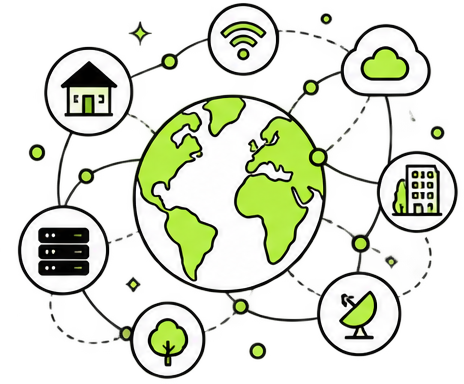
That’s the main idea.
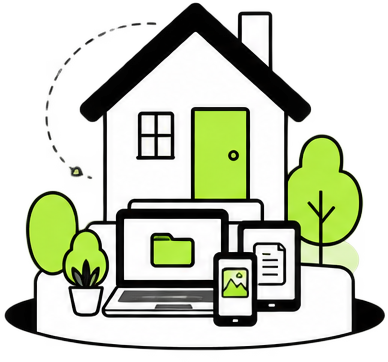
Think of your phone, tablet, or computer like your house. Inside that house are the things stored directly within that device: files, photos, programs, documents, and other information.
But your house doesn’t exist alone. There is a huge world outside of it, filled with other places to go.
That outside world is what we experience as the internet.
Your Device Is Your House
When something is already saved on your device, it’s inside the house. You don’t have to go out and get it every time you want to use it because it's tucked away with you, in your safe and private space.
But a lot of the things we do on our devices require us to reach outside.
Viewing a business, searching information, checking the weather, or sending an email, all involve your device communicating with something somewhere else.
Information leaves your house, information comes back in, and all of this happens through roads and connections working quietly outside.
That’s why the internet can feel like one giant “thing,” even though it really isn’t one single object or place. It’s an enormous connected world.
Things Move In and Out
Once you picture the internet as the outside world, a lot of familiar digital actions start to have a little more context.
Your device can:
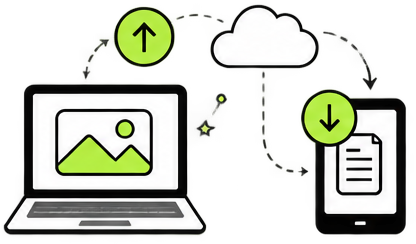
send information out = uploading
bring information in = downloading
So How Does Everything Travel?
Just like the world outside your house has roads connecting different places, the internet has connections that allow information to move around as well.
For now, picture roads. Your device connects to a much larger system, which allows information to travel from one place to another. Like a house existing within an endless city.
Your house connects to a road. That road connects to other roads and leads to various places in the outside world. This is being ‘connected to the internet’; if you don’t have any road leading into the world from your house, the internet is still out there, but you are not connected to it; nothing comes or goes from your house.
The Internet is the world outside of your ‘house’.
Websites are the other houses and buildings that are also connected to the internet, just like yours.
Just like buildings in the real world have different purposes, builds, layouts, displays, colors, styles, and more, websites do too. Some are built to sell products. Some are built to share information. Some are built to display photos and artwork. Others are built to help people contact a business, fill out forms, or learn something new.
Every website is a place with an address and location in the internet that was built by somebody - and for a specific reason.
For example:
An online store is a website.
A business website is a website.
A news website is a website.
A blog is a website.
A photo gallery is a website.
Facebook is a website.
Google is a website.
They may all look and function different, but they're still websites.
What “Using the Internet” Really Means
When someone says they are “using the internet,” they’re really describing all kinds of different activities happening through this connected outside world.
They might be visiting a website, sending a message, watching a video, searching for information, uploading a photo, or downloading a document.
Those activities are different, but they have something in common: the device is communicating with something outside itself.
That’s the part worth remembering.

The internet isn’t one website. It isn’t Google. It isn’t a browser, an app, or the little Wi-Fi symbol at the top of a screen. It’s the connected world that contains all of those things.
A Simple Way to Remember It
Think of your device as your house.
Inside are the things stored directly inside of it. Outside is a much larger connected digital world filled with other places and information. Your device can send things out, receive things back, and visit places through the connections between them.