
Getting Started: What Is a Website?
A website is a place on the internet.
That's really the heart of it.
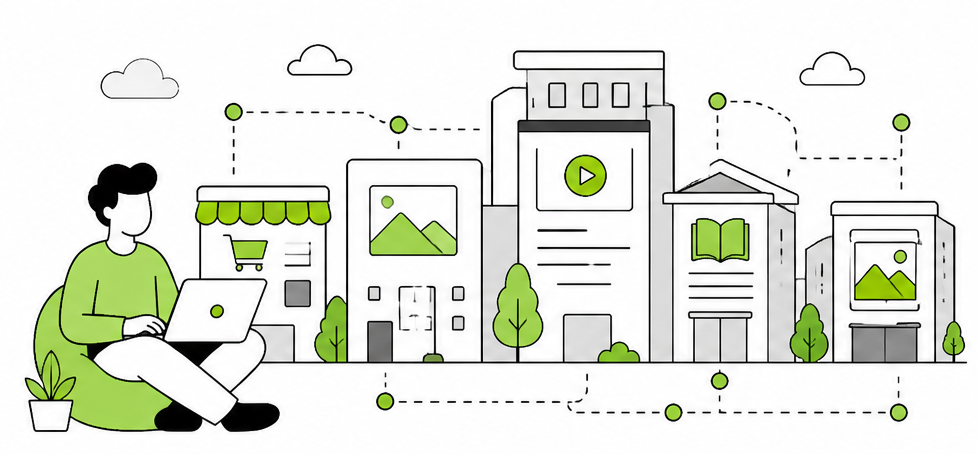
In a previous post, we talked about the internet as the world outside of your device. It’s just the vast world outside, where information travels from one place to another. And if the internet is full of roads and places, just like the outside world, then there also needs to be places those roads lead to.
Those places are websites.
A helpful way to picture a website is to think of it as a building.
Just like buildings in the real world have different purposes, builds, layouts, displays, colors, styles, and more, websites do too. Some are built to sell products. Some are built to share information. Some are built to display photos and artwork. Others are built to help people contact a business, fill out forms, or learn something new.
Every website is a place that was built by somebody - and for a specific reason.
For example:
An online store is a website.
A business website is a website.
A news website is a website.
A blog is a website.
A photo gallery is a website.
Facebook is a website.
Google is a website.
They may all look and function different, but they're still websites.
And just like a building has an address, every website has an address too.
Without an address, it would be difficult to find a specific building. The same idea applies online. Every website has a unique address that tells your device where to go. This is why you are sometimes asked to ‘type in the address’.
Tip: Website addresses can also be referred to as ‘URLs’, or ‘Links’ - they all mean the same thing.
Tip: A link is something you can click that will bring you to a website. It is a link between where you are currently, and another place on the internet. Like → THIS. Hint: Text links are usually underlined.
When you type an address into a browser, click a link, or select a search result, your device is being directed to a specific website.
Once you arrive, there's usually more than one thing to see.
Most websites are made up of multiple pages that are connected together. You can think of these pages like different rooms or sections inside a building. They all belong to the same place, but each section has its own purpose.
A business website, for example, might have:
a home page
an about page
a services page
a contact page
A large website might have dozens, hundreds, or even thousands of pages connected together. In fact, you are likely reading this article on a website page this very moment!
As visitors, we move between these pages by clicking links, menus, buttons, and images. Each click takes us to a different section of the same website or sometimes to an entirely different website.
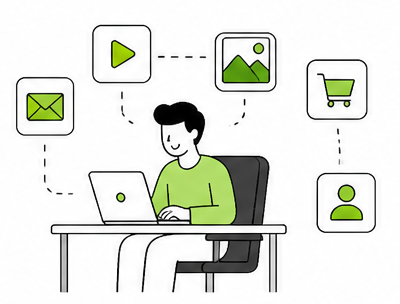
One thing that can make websites feel confusing at first is that they come in so many different shapes and sizes. Some are small and simple. Others are enormous. Some contain only a few pages, while others contain enough information to fill entire libraries.
Despite those differences, they all serve the same basic purpose: they provide a place where information, services, products, ideas, or experiences can be shared with others online.
When everything is put together, a website is simply a location on the internet. It has an address, it contains pages, and it exists so people can visit it and interact with what is there.
Just like buildings exist in towns and cities, websites exist on the internet.
They're the places we visit every day, often without even thinking about it.